Why a Weekly Dance Practice Session Helps More Than Random Social Dancing
Going out social dancing sounds like the best way to improve.
You hear the music.
You dance with different people.
You practice in a real environment.
You get to experience the energy of the room, the songs, the connection, and the excitement that made you want to learn salsa or bachata in the first place.
And social dancing can absolutely help you grow.
But for many beginners, going to random socials without a plan can also feel confusing.
One night feels amazing.
The next night feels awkward.
One partner makes everything feel easy.
Another partner makes you feel like you forgot everything.
You may leave wondering if you are actually improving, or if you are just repeating the same mistakes with louder music and more people watching.
That is where a weekly dance practice session can make a big difference.
A practice session gives you the benefits of social dancing, but with more structure, more support, and more time to actually understand what is happening.
It is not about replacing socials.
It is about helping you enjoy them more.
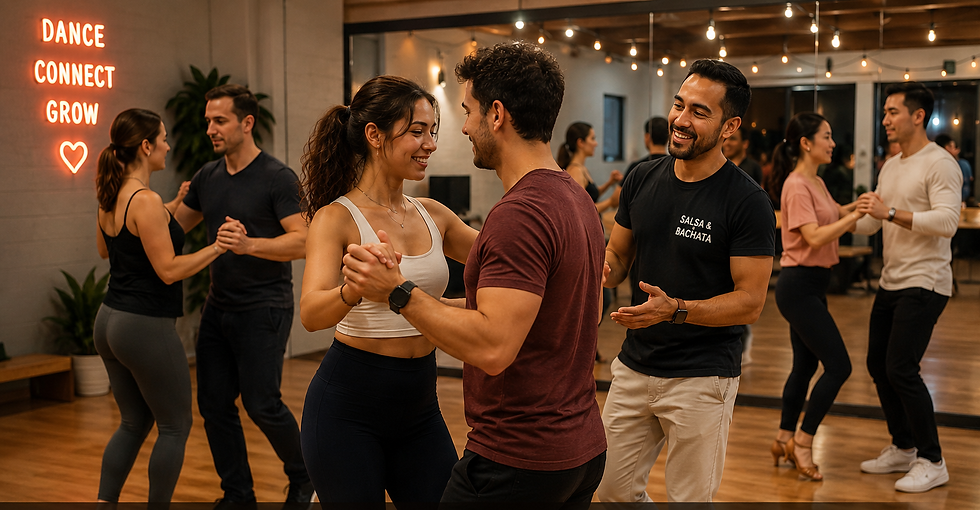
Social Dancing Is Fun, But It Can Be Overwhelming
Your first few salsa or bachata socials can feel like stepping into a completely different world.
The music is faster than you expected.
People seem to know what they are doing.
The dance floor may feel crowded.
You may not know when to ask someone to dance, where to stand, how much space to use, or what to do when you forget a move.
Even if you have been taking classes, the social floor can feel very different from the classroom.
In class, the instructor breaks things down.
You know what pattern you are practicing.
Everyone is learning the same material.
There is time to ask questions.
At a social, everything happens in real time.
The song does not stop just because you got confused.
Your partner does not know what move you were trying to lead.
You cannot pause the whole dance floor to ask, “Wait, what happened?”
That is why many students feel good in class but unsure at socials.
It does not mean you are bad at dancing.
It just means you are entering a new environment, and your brain is trying to handle a lot at once.
A weekly practice session gives you a bridge between class and the social floor.
Practice Sessions Give You Room to Slow Down
One of the biggest problems with only going to random socials is that everything moves quickly.
You dance one song.
Then another.
Then another.
If something does not work, you may not know why.
Was the lead unclear?
Was the follow anticipating?
Was the timing off?
Was the connection too tense?
Was the turn too rushed?
Was the music faster than you were ready for?
At a social, you may feel the problem, but you do not always have the space to fix it.
In a practice session, you can slow things down.
You can repeat the same step more than once.
You can ask a question.
You can try the move with different partners.
You can notice what changes when you relax your shoulders, listen to the beat, or make your lead clearer.
That repetition matters.
Dancing improves when your body has time to understand what your mind already heard in class.
A weekly practice session gives your body that time.
You Get Feedback Before Bad Habits Become Comfortable
The tricky thing about dance habits is that they can feel normal even when they are not helping you.
You may not realize you are gripping too hard.
You may not notice that you are rushing the count.
You may not feel that your frame disappears during turns.
You may think a move is not working because your partner is confused, when the real issue is that your preparation was unclear.
That is not something to feel bad about.
Every dancer has habits they cannot see at first.
The difference is whether someone helps you catch them early.
When you only go to socials, you may repeat the same habits over and over because nobody stops to explain what is happening. People may smile politely, finish the song, and move on.
That can keep you stuck.
A practice session gives you a place to receive small corrections before those habits become automatic.
And small corrections can change everything.
Sometimes one adjustment makes a turn feel smoother.
One timing cue helps the whole dance feel calmer.
One reminder about posture makes connection more comfortable.
One explanation helps you understand why a move works in class but falls apart socially.
That kind of feedback can save you months of guessing.
Weekly Practice Builds Confidence Through Familiarity
Confidence does not usually appear all at once.
It builds slowly.
You show up once.
Then again.
Then again.
You start recognizing faces.
You start remembering songs.
You start understanding the structure of a dance.
You stop feeling surprised by every little mistake.
That is one reason weekly practice is so powerful.
It gives you a familiar place to grow.
Random socials can be exciting, but they can also feel unpredictable. Different venues, different crowds, different music, different levels, different energy.
That unpredictability can be fun later, but in the beginning it can make everything feel harder.
A weekly practice session gives you consistency.
You know where you are going.
You know the environment is focused on learning.
You know it is okay to ask questions.
You know people are there to practice, not just to show off.
That feeling helps you relax.
And when you relax, you dance better.
You Learn How to Dance With Different People
One of the best parts of partner dancing is also one of the hardest parts.
Every person feels different.
Some leads are gentle.
Some are strong.
Some are clear.
Some are still learning.
Some follows are light.
Some are grounded.
Some respond quickly.
Some need more time.
If you only practice with one person, you may get comfortable with that person’s habits. That can feel nice, but it may not prepare you for the variety of social dancing.
A weekly practice session helps you learn how to adjust.
You start noticing that the same basic step can feel slightly different with each partner.
You learn not to panic when someone has a different style.
You learn how to stay calm, listen, and adapt.
This is especially helpful for beginners because social dancing is not about memorizing one perfect version of every move.
It is about communication.
A good practice session gives you the chance to develop that communication in a safer, less pressured environment.
You Can Turn Class Material Into Real Dancing
A lot of students take class, understand the pattern, and then forget it the moment the music starts.
That is normal.
Class learning and social dancing are connected, but they are not the same skill.
In class, you may learn a turn pattern step by step.
But in real dancing, you have to choose when to use it, how to lead or follow it, how to stay on time, how to avoid other couples, and how to keep moving when something does not go as planned.
That takes practice.
A weekly practice session helps you turn class material into something you can actually use.
Instead of learning a move once and hoping it appears magically at a social, you get to repeat it, test it, simplify it, and connect it to music.
You also learn which moves feel comfortable for you right now.
Not every pattern needs to be used immediately.
Sometimes the best thing you can do is take one or two simple moves and make them feel smooth.
That is what makes you more enjoyable to dance with.
Not complexity.
Clarity.
Random Socials Do Not Always Tell You What to Work On
After a social, many beginners know how they felt, but they do not know what to improve.
They may think:
“I felt off tonight.”
“I kept missing the beat.”
“I forgot my patterns.”
“I felt nervous asking people to dance.”
“My turns were messy.”
“I could not connect with the music.”
Those feelings are real, but they are not always specific enough to help you grow.
A practice session can turn those vague feelings into clear focus.
Instead of “I am bad at turns,” you may discover that you are stepping too far away before turning.
Instead of “I have no rhythm,” you may realize you are hearing the beat but starting on the wrong count.
Instead of “I am awkward with partners,” you may learn that your frame is either too loose or too tense.
Once you know the real issue, improvement feels much more possible.
You stop blaming yourself.
You start working on something specific.
That is a much better way to grow.
Practice Sessions Help You Feel Less Alone
Dance can feel intimidating when you think everyone else is ahead of you.
At socials, it is easy to look around and assume that everyone is confident, everyone knows more, and everyone started earlier than you.
But in a practice session, you get to see the learning process more honestly.
You see other people asking questions.
You see other people repeating basics.
You see other people working through the same timing, connection, or confidence issues that you are working through.
That can be comforting.
You realize you are not the only one who forgets steps.
You are not the only one who gets nervous.
You are not the only one who needs repetition.
This matters because feeling supported helps you keep going.
Many people quit dancing too early because they think they are struggling alone.
A good weekly practice environment reminds you that learning is normal.
You Build Muscle Memory Without Pressure
Muscle memory is built through repetition.
But not all repetition is equal.
If you repeat something while tense, rushed, or confused, your body may learn the tension along with the step.
That is why practice needs to feel calm enough for your body to absorb the movement.
A weekly practice session gives you more chances to repeat the basics without the pressure of a full social setting.
You can practice timing.
You can practice connection.
You can practice turns.
You can practice asking someone to dance.
You can practice recovering from mistakes.
And the more you repeat these things in a supportive space, the less scary they feel later.
Eventually, you do not have to think so hard about every step.
Your body starts to remember.
That is when dancing begins to feel more natural.
Social Dancing Becomes More Enjoyable When You Are Prepared
The goal is not to practice forever and avoid socials.
The goal is to make socials more fun.
When you practice weekly, you start walking into social settings with more confidence.
You have a few moves you trust.
You understand the music better.
You know how to recover when something goes wrong.
You are less surprised by different partners.
You feel more comfortable with the basic rhythm.
That changes everything.
Instead of spending the whole night worrying about whether you are good enough, you can start enjoying the experience.
You can listen to the song.
You can smile.
You can connect.
You can dance one simple song and feel proud of it.
That is the real benefit of practice.
It helps you experience the joy of social dancing without feeling completely overwhelmed by it.
You Do Not Need to Be Advanced to Practice
Some people think practice sessions are only for dancers who already know a lot.
But beginners may need them the most.
You do not have to wait until you are confident.
You do not have to wait until you know more patterns.
You do not have to wait until you feel ready for the social floor.
Practice is where readiness is built.
If you know your basic step, you can practice.
If you are still working on timing, you can practice.
If you are nervous dancing with new people, you can practice.
If you forget moves easily, you can practice.
The point is not to arrive perfect.
The point is to show up, repeat, learn, and leave feeling a little more comfortable than when you walked in.
That is how progress happens.
Make Practice Part of Your Dance Routine
Random socials can be exciting.
Classes can teach you the foundation.
Private lessons can help you fix specific details.
But a weekly practice session gives you something different.
It gives you consistency.
It gives you repetition.
It gives you feedback.
It gives you a place to try, make mistakes, and improve without feeling like you have to perform.
If you want your dancing to feel better at socials, do not rely only on random nights out and hope everything clicks.
Give yourself a regular place to work on the pieces that make social dancing easier.
A weekly salsa and bachata practice session can help you build confidence, smooth out your basics, and feel more prepared when you step onto the social floor.
Because the goal is not just to dance more.
The goal is to enjoy dancing more.


